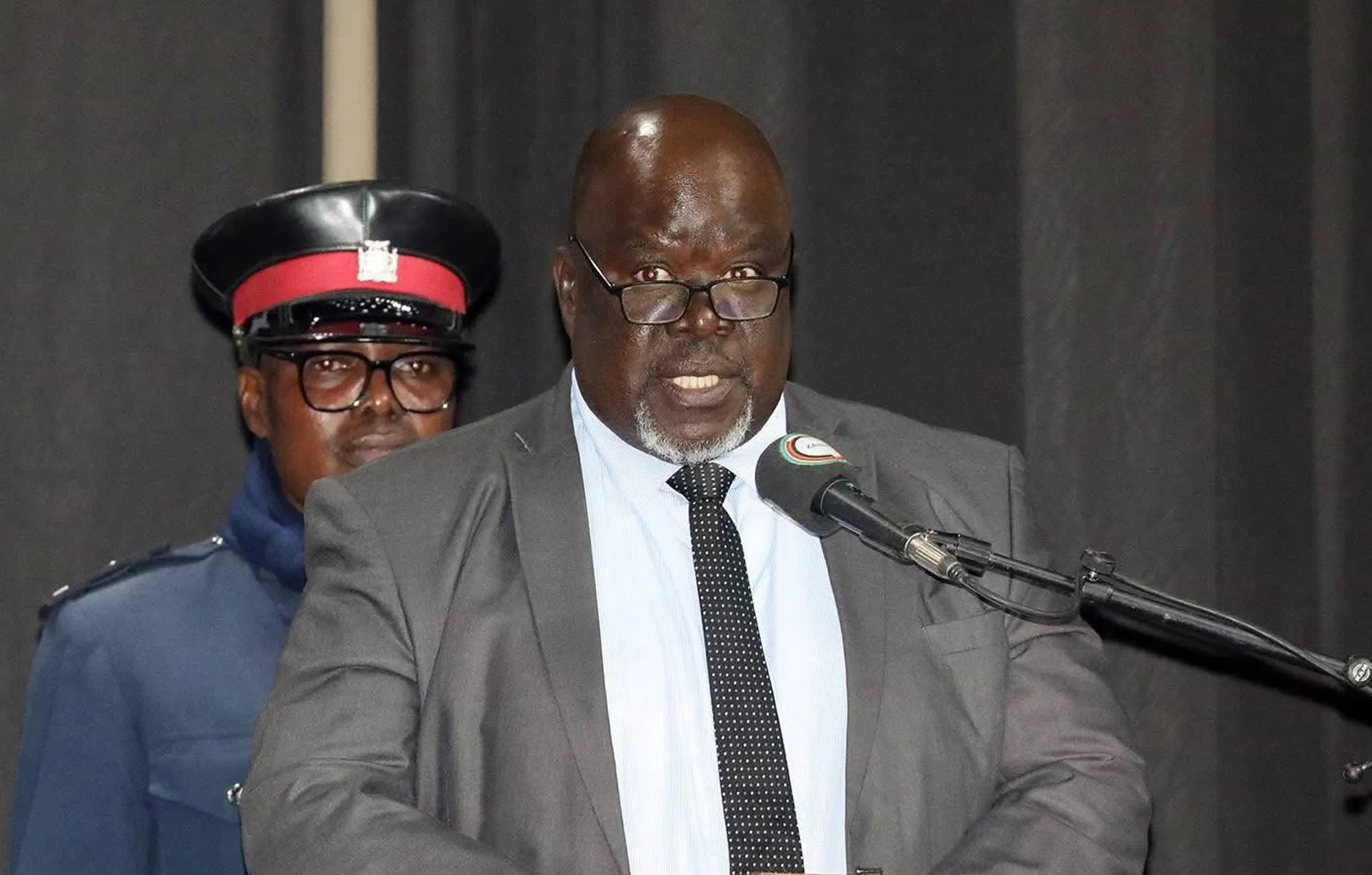
Sialubalo declares street vending illegal, says UPND does not support the practice
Get Breaking News on WhatsApp
Follow Kafue Times for real-time news from Kafue, Zambia and beyond — straight to your phone.
Join WhatsApp Channel →Sialubalo declares street vending illegal, says UPND does not support the practice
**Headline:**Local Government and Rural Development Minister Gift Sialubalo says street vending remains illegal in Zambia and the ruling UPND does not support the practice, despite its prevalence in urban areas.
LUSAKA – Minister of Local Government and Rural Development, Gift Sialubalo, has reiterated that street vending is illegal in Zambia and emphasized that the United Party for National Development (UPND) government does not support the practice.
Speaking during an appearance on Diamond Television on Thursday, Sialubalo acknowledged the widespread nature of street vending but maintained that the government was firm in its stance and had strategic plans in place to address the issue by offering alternative solutions to those affected.
“Street vending is real and it still exists, it’s a very serious issue,” Sialubalo said. “When you are carrying out a policy, it’s not a personal policy, it’s a national policy anchored on what that particular party in government believes in. We don’t believe in vending; it’s illegal.”
He stressed that while the activity is widespread and visible, the UPND government would not compromise on enforcing the law. He revealed that plans were underway to work closely with the Lusaka City Council to implement measures that promote orderliness in the Central Business District (CBD).
“As a government, we have a plan on how to tackle this. We are not compromising. It’s not personal this is a policy of the government. And we have an agenda on how to handle this together with the Lusaka City Council,” he added.
Sialubalo disclosed that part of the beautification initiative would involve upgrading the Kabwe and Kafue roundabouts in the Lusaka CBD, after which enforcement actions would commence.
“You will soon see contractors working on the Kabwe and Kafue roundabouts. Once we begin beautifying these places, we will then begin engaging the vendors to move out. We want to demonstrate what a clean city looks like, rather than just chasing people without a clear plan,” he explained.
He further stated that street vendors would be given direction, not merely pushed out, as the government aims to strike a balance between enforcement and provision of alternatives.
On a different note, Sialubalo also addressed concerns about the Constituency Development Fund (CDF), rejecting suggestions that rural areas were seeing minimal impact from the programme.
“Let me correct you when you say the rural part of the country is seeing little impact that is not a good narrative. The rural part of the country is actually seeing a lot of impact under CDF. Previously, MPs would serve a five-year term without bringing any meaningful development. Today, every MP has no less than 40 projects under CDF,” he said.
Sialubalo acknowledged that urban constituencies may appear to be seeing less visible progress, but attributed this to the already developed nature of cities, where it is difficult to distinguish CDF projects from existing infrastructure.
“If you build a one-bythree classroom block in Matero, for example, people passing by won’t even notice that it’s a CDF project until it’s completed. In rural areas, however, it’s more noticeable because of the development gap that existed,” he said.
The minister, who is also the UPND Member of Parliament for Sinazongwe, revealed that his own constituency had initiated more than 60 projects under the CDF framework.
“Sinazongwe has more than 60 projects under CDF. And let me be clear, I don’t decide how the money is used. It’s the people in the wards who propose the projects. As MP, I sit on the CDF Committee as an ex-officio member I don’t bulldoze decisions,” he clarified.
About the Author